Showing posts with label Denial. Show all posts

Saturday, 17 December 2016

Blame Yourself If You Keep Buying The Snake Oil


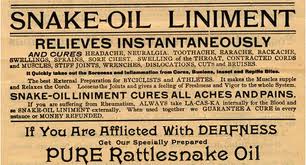
When you’re buying the fifth bottle of Snake Oil it’s time to look at yourself, not blame the salesman for his product being a fraud.

Who to trust, Putin or the CIA?
When America is told by security services experts who have served both Republican and Democratic governments, some for decades, that a foreign power attempted to and possibly did influence elections to choose her leader, you’d have thought the President Elect would listen. When the same agencies questioned the inappropriate use of private emails for state business by Hillary Clinton, the then campaigning Donald Trump threatened to investigate and even put her in jail. But no. the same agencies are saying President Putin authorised or knew of the cyber-attack on the Democratic National Committee's emails, the same, now president Elect Trump, says their advice can’t be trusted. Weren’t they, he now says, the same people who claimed there were weapons of mass destruction in Iraq leading to that country’s invasion? But America, the nation that bought the snake oil from the salesman is caught in the headlights not knowing what to think, who to believe, their security services or their greatest adversary in President Putin.

Gaslighting
She can’t blame the salesman who conned her into the first bottle of snake oil now she has bought and consumed so many bottles. This is the sales man that buys 800 jobs for a $7million kickback to Carrier Corporation for keeping those jobs in the USA, and sells it as evidence of his economic wizardry. Set this against the 168,000 jobs that were legitimately created in the USA that month without crony capitalism, and that went almost unremarked in the media or by the voters.  Only a change in America and its people’s attitudes will stop her buying more and more of a product of highly dubious worth.

If America continues to lie to herself, she remains vulnerable to further gaslighting by her new elected leaders. All the snake oil salesmen are having to do is repeat the lies America tells herself and which she so desperately fears to confront.

The biggest lie of all 

The biggest of these lies is that America is egalitarian, that she values all people equally. America says she is not racist, that her institutions are not predicated on maintaining the social economic and political superiority of any white Americans over any other Americans. But that's exactly the opposite of the truth. Any policies or activities that will deliver the prime yet  vociferously denied need to maintain white privilege there will pass muster among the masses. The nation will continue to buy the oil from the salesman as she gets sicker and sicker. The promises to “drain the swamp of establishment insiders”, to control immigration, to control abortion, to maintain law and order - all are cyphers for maintaining the established heirarchy in the USA, especially if the ostracised parties can in any way be associated with the liberalism that diminished white power in America. Many women voters went for this pitch, sacrificing their dignity on the alter of their soon to be restored ethnic superiority.  Buyer beware. Wake up. The medicine you’re being sold certainly diminishes your perceived enemies but will undermine the sovereignty, ethics, morality, cohesion and international dignity of your nation. Everyone can see America is being conned. Her enemies will enable it all they can, but only Americans can start owning their truths and lies to change this situation. 

Tuesday, 19 January 2016

6 things I've Learned About Denial That Directly Impact Diversity.


Diversity is about our ability to embrace people from varied backgrounds with respect and ease. To do this requires the social skill of viewing things from multiple perspectives so we can accept new ideas and new ways of doing things. In business, where "innovation" has become the word du jour in recent times, and society in which people of diverse backgrounds are more and more in our spaces, our ability to embrace diversity not only makes us mores successful business wise but also happier as individuals. In a working life spanning several decades I have discovered that the human tendency toward living in denial is perhaps the greatest roadblock to our ability to embrace diversity as a way of life and doing business. Here are 6 things about denial, not all bad, that directly impact our ability to embrace diversity.


1. Keep Calm And Carry On

When we live in denial of any reality we numb ourselves to the impact and presence of that reality. A good example is bereavement. When first told of the loss of a loved one, many people just cannot accept that they will never, and I mean never, talk to, laugh with, drink with, hug, hold kiss that person ever again. The reality is so awful we numb ourselves to it and subconsciously deny it’s happened. Not a bad thing if you have to comfort others reeling in shock, organise funerals and the like. You are numb with shock, but crucially are able to function because of the shock.


2. Let’s Face The Music And Dance

Well that’s not entirely true, you actually deny the mood music and dance anyway, because denial enables you to keep up your spirits, even make light of and joke about the awful event that you can’t face. Again, useful in the short term. Who wants dive into a bottomless depression and fall apart? There’s the famous anecdote of the paratroop officer on Arnhem bridge in WWII whose lightly armed men, facing a crack tank brigade, were being torn to shreds in that ill-fated action. He carried an umbrella throughout the fight and explained to his men just before he died, “I’m hopeless with passwords but everyone knows that only an Englishman would be mad enough to carry a brolly onto a battlefield, so our boys would always know I was one of them.” Total denial to the point of surrealism, but he kept his men’s spirits up to the end!


3. Dodgy Logic.

We deny reality by minimisation, rationalisation and fantasising, using their logic to hide from the facts. Minimisation as in “Oh come on its not that bad really is it?” or “well look on the bright side, things are getting better aren’t they?” This is the logic which says, look on the bright side, the terrorists at Charlie Hebdo could have killed 20 or 30 journalists not just 12.


Rationalisation to maintain denial is where explanations for behaviour are made without comment on the value or worth of that behaviour. Saying that “well he behaves like that because he’s never met anyone from that background,” may well be true, but fails to acknowledge that the behaviour itself is hateful or inconsiderate. Rationalisation feels to its victims like an excuse for bad behaviour.

Fantasising, living in a dream world seems bizarre for adults but is very common and is one way of dealing with unpleasant or thorny problems we cannot face. It’s almost as if by repeating the fantasy often and long enough reality will disappear, but of course it never does. Examples in daily life are pretending you did not very publicly snub someone just the day before, yet meet them cheerily at the next occasion. The denial is so effective that the victim asks themselves, “did I imagine what happened yesterday?”, which of course they didn’t. Other ways in which fantasies are maintained is censorship of speech where certain subjects including diversity itself are just not welcome in polite conversation. The unease created is a powerful way in which groups are held in line with the fantasy. If no one is talking about it, then it cannot be happening says the dream.

4. Denial Maintains The Status Quo.

Denial of a situation helps maintain stasis and never addresses the problem. If an issue has been censored from sight, it can’t exist and of course will never be addressed. How can you solve a problem that does not exist?


5. Denial Is The Perfect Growth Medium For Impending Catastrophe.

Any problem facing an individual or a business metastasises and grows when not addressed. The problems can be hidden in plain sight but owing to a collective denial of the issue it can grow to the point it becomes totally toxic to the larger community before it’s addressed. This happens in personal relationships, in businesses and in communities. Couples slowly growing apart,  Group Think  in businesses leading to awful decisions are all examples. Why did our society not see radicalisation  looming over the horizon, given years of social statistics indicating exclusion in certain demographics? Why did it take so long for the authorities to act despite countless allegations of paedophile activity by high placed celebrities like Sir Jimmy Savile . By contrast, diversity and other social challenges which are widely spoken of without fear of censorship (such as women’s rights) see continued progress even though resistance to them is deeply embedded in prevailing cultural values and memes.


6. Denial Does Not Stop By Itself.

People need permission and an enabling environment to stop denying realities that may be toxic to themselves, their businesses and their communities. Individuals and usually those in positions of social, executive or opinion forming authority usually need to take the lead and champion a constructive way of dealing with the issue being denied. On a personal level, each individual has to decide (or not) for themselves to liberate their thinking and way of being. The rewards are plentiful – an enriched life based on reality, and an improved sense of self-worth that is shame and guilt free. Denial of reality holds us all back and limits our lives to a fraction of the possibilities we can help ourselves and others enjoy.

Your comments on Denial are welcome. Can you add insights on the subject?

For coaching in managing diversity email Tet Kofi Media at tet@tekofi.com.


Sunday, 13 December 2015

Five Lessons For Business From One Thing Black Parents Teach Their Children


Almost every black parent has “that” conversation with their children when they intone words to the effect “You've got to work ten times harder than the others to get ahead.” I first heard that from mine around age 13. I didn't really pay attention. Add a public school environment to my age and I felt more or less invincible.  I was very wrong because the science proves that there is much wisdom in this advice, and while minority ethnic families have freely bandied it about for generations, your business can take 5 lessons from it that will make your staff more productive, your customers more satisfied, and your reputation much stronger; all effects that flow straight to your bottom line.

In-Groups

The first lesson is that people form in-groups in any community including companies. Members of our in-group are those we identify with and support. They are chosen for the likelihood of their giving us positive feedback about ourselves. In-group members are a kind of fan club who help us maintain a positive self-image and are therefore welcome. We view them as individuals, are able to overlook their quirks and even see these sometimes as the very things that make them unique and attractive. In meetings we refer to them by name, quote their contributions, make eye contact are relaxed around them and so cause them to feel more confident to contribute, take punts at flying edgy ideas, which even if not accepted are still applauded as creative attempts. We evaluate their work and output higher, and are sympathetic when in-group members fail or stumble.

Out-Groups

The second lesson is that there are others in our communities who we place in the category of out-group members. They are people we don’t identify with and typically won’t look for or expect positive feedback from. Despite being co-workers, they are definitely the “away” team and though afforded basic courtesies get no positive passion from us. We see out-group members as a homogenized group and are unable to see their quirks as endearing or indicative of a unique personality. Their ways are more likely to be seen as deviations from the “norm” (of our in-group) and further proof that they really are not part of us. In meetings we don’t quote them, refer to their points, mention them less by name, and won’t be as open to their creative punts, more likely seeing them as of little merit or unworkable. It is very easy in a group of say 5 people for the 3 people who form part of our in-group to shut out the two who are seen as  members of the out-group, without noticing that this is what we are doing. Complaints from members of the out-group are unsympathetically heard and often attributed to the stereotype we have prior formed about “such people” – stereotypes such as being anti-social, disengaged, defensive, uncreative, of less merit and the like. Of course the behaviour of the in-group will by its very nature enable and increase the manifestation of these stereotyped behaviours which then become self-fulfilling prophecies. “See?  I always suspected that’s how he or she (out-group member) is,” an in-grouper would then think.  

Informal Networks

The third lesson is that creating in and out groups will naturally exclude out-group members from the informal networks that every organization needs to promote its work. These networks are the places where social engagement gives access to decision makers, influencers, opinion formers, and sometimes the nuanced information required to do a job well. New opportunities for career development while passing through the formal networks are often best accessed through these informal networks. Exclusion from informal networks mean out-group members will very likely not do their jobs as well,  gain access to the privileged information they need or progress as quickly up the career ladder. This of course will be seen as further evidence to in-group members of out-group members belonging in the out-group because they’re “just not as good!”

Mentoring and Grooming

The fourth lesson for companies derives from the third. It is by having access to the informal networks that individuals are mentored and groomed for career development. There are hard skills and soft skills in any job, so while two candidates may be equally qualified in the hard skills, the “softer” nuances of the job which really differentiate the rookie from the rock star will not be made available to out-group members. This is simply because they were excluded from the sources and exposure that provide those insights. Mentors have a percentage in those they foster and nurture. They tend to look for opportunities to guide their wards onward and upwards too, an arrangement that works always to the advantage of those accepted into the informal networks. People always pass the ball to members of their own team.

Living In Denial

The final lesson for companies is that they will likely live in denial of the 4 effects outlined so far, and blame them on the inherent nature or behaviour of out-group members. This is what social psychologists call a  classic attribution error where individual nature is seen as the cause of an event without realising that the environment is exerting heavy pressure to shape the outcome of events and behaviour.  While attribution errors by in-group members may look intentional to members of the out-group, in-group members are in fact often completely unconscious of these errors. The simple truth is that people like people like us!

Membership of in and out-groups may be formed along lines of race, gender, sexual orientation, age, class, in fact any significant cultural or demographic trait that marks one individual as VISIBLY or behaviourally different to others. These exclusions hurt the company, its profits and may damage its reputation. They can limit access to markets, ruin group harmony, significantly reduce the productivity of staff, and destroy the creative spark in a company because creativity is found at the confluence of multiple or different viewpoints. The insights above derive from the work of social psychologists including Henri Tajfel and John Turner in the 1970’s and is founded in the science behind Social Identity Theory.  So while black parents may not have understood the science behind their statements, there was much wisdom in what they have passed down. If you’re a member of the out-group, you have your work cut out for you, and smart companies will work hard to understand and manage the negative impacts of social interactions at work. Leave your comments on your experience of these lessons here, they are very welcome.

I have coached senior management teams on managing diversity in large and small organisations. My clients have included L’OrĂ©al in 5 Countries (UK, Holland, Switzerland, Hungary, Czech Republic) The British Army, Logica (CGI), The European Commission in 4 countries (Spain, Iceland, Germany, Slovenia), British Aerospace (Warships Div.) in the UK, The Cabinet Office and a host of SMEs in the UK. Email tet@tetkofi.com for further information on how I could help your organisation or start-up.


Saturday, 20 September 2014

Plausible Deniability - The Meme That Drives Modern Exclusion


The sky should be the limit
 Ever try swimming without water, or playing tennis on your own? Both are zero sum games that go nowhere. It’s the water that provides the buoyancy and if you partner does not return your serves you run out of balls, the game has to stop.

Tidal wave of impacts
Modern discrimination is not about calling people nasty names or epithets. That is so yesterday. Use the “N” or “P” word and most modern fascists would go “tut tut” and all liberals would jump down your throat. Such blatant abuse is universally despised and indefensible. Modern discrimination is not like this at all, on the contrary it is plausibly deniable. It manifests as little actions which taken individually have little weight, and which if responded to make the actor look hyper sensitive or even paranoid. Examples, say in the context of a meeting would be; repeatedly forgetting a participant’s name; not making eye contact; not listening or paying attention to what they say, followed by not referring to anything they say; not inviting their views on the subject; not inviting the subject to participate in the group conversation; being distant from them or sometimes being over familiar in a way that violates their personal boundaries. None of these actions are on their own sufficiently weighty to merit a response without looking aggressive or defensive. Together however, they form a tidal wave of impacts that exclude the person from the meeting literally as if they had never been there.

Plausible Deniability
Because none of the individual actions are strong enough to merit a response they become plausibly deniable. Plausible deniability was a doctrine first devised by the CIA in the fifties as a tactic for protecting senior officials from the consequences of official malfeasance. If the senior officials knew nothing of what was being done they could publicly plausibly deny whatever they were accused of thus protecting themselves from any legal or political blow-back. In this world of smoke and mirrors no one knows what is going on or indeed if anything is going on at all. If there is no discriminatory behaviour then there is no problem to solve. The denial and deniability of modern discrimination is its very defence.

Exclusion always impacts performance (pic by Blogman)
The impacts of exclusion by tiny acts of non-acknowledgement, each plausibly deniable, for a business, an institution or a society is always catastrophic. The excluded party‘s performance declines as the motivation to participate drops following habitual exclusion.  Jane Elliot and her controversial Blue Eyes Brown Eyes experiment with third grade American schoolchildren dramatically shows what happens to performance when people are stereotyped and systematically excluded. I found it a powerful tool for teaching management skills to very adult senior executives of multinational corporations round the world, and the lessons are clear. This decline in output or performance by the excluded party provides an excuse or rationale for further exclusion, after all they’re just not pulling their weight. After a while the victim of exclusion is presented as the cause of their own downfall if not the perpetrator of their own “self” exclusion.

Exclusion
The Glass Ceiling - palpable but deniable
Just like the lottery, you've got to be in it to win it. Without  a paid ticket there is no chance of scooping the jackpot. Without participation in the meeting, the business, the society, the discussion, there is no way of constructively influencing it or maintaining your performance. Any more than you could swim without water. Now think about politics. How do disenfranchised groups feel and what forces are at play in their disenfranchisement? Think about why as many as 45% of Scots voted to become independent in the recent   referendum. Think about how women feel in the work place - are they really included, and how does this affect their output? Think about race and how minority ethnics are included or excluded in the work place. I became self-employed when I realised I’d reached a glass ceiling in the UK. The stereotype of an articulate, cultured, well-travelled, well-educated black male who was focused and determined just did not exist in the popular imagination. The presence of the very few prominent non-caucasian men in senior positions just feeds the plausible deniability of the possibility of discrimination. My work environments responded by just ignoring my existence and then very plausibly denied it. If this ever happens to those who are less thoughtful or life experienced, the consequences can be far more dire. Younger men with less life experience are infinitely more vulnerable to extreme, uber-radical ideas that give them a sense, however fantastical, of belonging and being worthy. It will of course always be their fault for falling prey to nihilism in the case of religious fanatics, but let’s not imagine that the environment played no part in this awful scenario.

The big issue is the plausible deniability of how exclusion works, for with denial comes the option to not take responsibility for the tiny acts which together create a tidal wave of impacts.